
 We are excited to share the priorities guiding our work over the next three years to strengthen
partnerships, expand awareness, and equip communities to better respond to abuse in later
life.
Over the past months, our team at the National Clearinghouse on Abuse in Later Life (NCALL) has taken time to hear from our stakeholders and reflect on where we are as an organization and where NCALL can have the most impact in meeting those needs. We asked ourselves – what will it take for older adults to age with safety and dignity? While there is no clear and simple answer, we know for certain it will take collaboration and innovation. Our 2026-28 strategic plan reflects this clarity.
What drives us is the belief that all survivors deserve equitable access to services that reflect their lived experience and truly meet their needs. We know that responses to abuse are not consistent. Survivors’ experiences can vary depending on where they live and their background and identity. Many victims are met with belief, care, and effective support, but that is not guaranteed and there are still many who remain underserved. Older adults are among those too often overlooked, particularly when age intersects with other forms of marginalization. If we believe everyone deserves to age with safety and dignity, that inequity is not acceptable. This understanding shaped the priorities we’ve set for the years ahead.
At its core, our direction remains grounded in our mission to engage communities in building collaborative, inclusive, survivor-centered responses to abuse in later life. Our vision is simple but clear: a society where older adults are respected, and communities work together to ensure their safety and dignity. Over the next three years, we will advance this vision through four priorities that strengthen our impact while ensuring that as an organization, we can sustain this work for the long term.
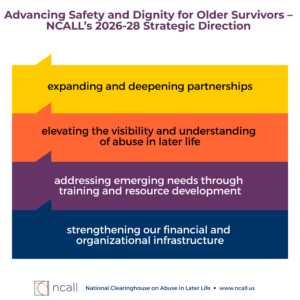
First, we are expanding and deepening partnerships to promote survivor-centered approaches. No single organization can address abuse in later life alone. In addition to strengthening existing partnerships with domestic and sexual violence programs, aging services, adult protective services and justice system partners, we will build new partnerships to meet emerging needs – health care providers, financial services, housing programs, and culturally specific organizations all have a role to play in preventing and addressing abuse later life. Stronger partnerships mean older survivors encounter coordinated systems that are prepared to work together toward safety and justice.
Second, we are elevating the visibility and understanding of abuse in later life. Too often, older survivors are overlooked or siloed in conversations about gender-based violence and elder justice. We are refining our national messaging so that abuse in later life is better understood – and so older survivors are seen, believed, and effectively supported. We will grow the reach of our awareness efforts with partners and the public and ensure ageism is called out as the barrier it is for older adults. When awareness grows, so does the field’s ability to respond.
Third, we are addressing emerging needs through training and resource development so communities are prepared to identify, reach and serve older victims and survivors. By launching new resources for professionals who serve older adults, we will build their capacity to effectively respond to abuse in later life.
Finally, we are strengthening our financial and organizational infrastructure – expanding our network of supporters and diversifying our funding, so that NCALL remains a stable, trusted national leader for years to come.
NCALL’s work has always been grounded in partnership, and the years ahead will require even deeper collaboration and thoughtful innovation. The landscape of abuse in later life is changing, and our response must adapt to this. Every partnership we develop, every training we deliver, every message we refine is in service of a larger goal: ensuring that older adults experiencing abuse are met with compassionate, caring support that promotes their safety, dignity, and justice. On behalf of the NCALL team, I look forward to working alongside our partners, supporters, and communities as we move into this next chapter together.
NCALL values each and every one of our partners and supporters and we invite you to stay connected with us on our renewed journey. If you haven’t already, sign up for the NCALL Community Update mailing list or follow us on LinkedIn and Instagram. On behalf of the NCALL team, I look forward to working alongside our partners, supporters, and communities as we move into this next chapter together.
–Kristin Burki, Director
Download a printable version of the blog post.